Aircraft artwork
Aircraft silhouettes illustrate 97 aircraft types. Individual additions and references are listed below.
Reference-guided artwork uses outlines by RexKramer1 / AircraftShapesSVG, licensed under GPL-3.0. The outlines were converted into filled silhouettes on 5–6 October 2026.
Download the original 58 silhouettes, sources, license and prompts.
Download the 13 upcoming silhouettes, sources, license and prompts.
Download the C550 silhouette and generation prompt.
Download the B739 silhouette and generation prompt. This additional silhouette was generated with the built-in image_gen tool on 10 October 2026, using the supplied Boeing three-view drawing for geometry and the Boeing planning manual for dimensions.
Download the reference-traced GLF5 SVG and notes. This replacement is a native vector outline traced on 10 October 2026 from the supplied G550 marking and painting drawing.
Download the B738 SVG and tracing notes. This native vector silhouette follows the 737-800W top-view outline in Boeing D6-58325-7 Rev C, section 2.2.6.
Download the B748 SVG and tracing notes. Prepared on 11 October 2026 from the 747-8 top view in Boeing D6-58326-3 Rev D, section 2.2.2, with native vector curves and restrained transparent detail.
Download the B789 SVG and tracing notes. Prepared on 11 October 2026 from the 787-9 top view in Boeing D6-58333 Rev P, section 2.2.2, preserving the model proportions, raked tips and twin-engine layout.
Download the Learjet 60 SVG and tracing notes. Prepared on 12 October 2026 from the reviewed Learjet 60 three-view.
Download the C25B Citation CJ3 SVG, reference outline, GPL-3.0 license and notes. Updated on 12 October 2026 with a native vector based on RexKramer1/AircraftShapesSVG, checked against the Cessna specification dimensions.
Download the HondaJet HDJT SVG and reference notes. Prepared on 12 October 2026 from the production HA-420 Pilot's Operating Manual three-view reproduced in NTSB ERA22LA150 Figure 2, preserving the over-wing nacelles, winglets and T-tail.
Download the Challenger 300 CL30 SVG and tracing notes. Prepared on 15 October 2026 from the Bombardier Flight Crew Operating Manual, CSP 100-6, section 01-02-02, with the outline checked by overlay against the dimension schematic.
Download the SW4 Merlin IVA SVG and tracing notes. Prepared on 15 October 2026 from Fairchild SA226 Merlin/Metro Servicing and Recovery Manual, Figure 1-2. Uses the long-body SA226-AT configuration, with the original curves and an overlay check against the reference top view.
Download the SW3 Merlin IIIA SVG and reference notes. Prepared on 15 October 2026 from the SKYbrary / EUROCONTROL SW3 three-view, with the short SA226-T fuselage, straight tapered wings and twin turboprops. Checked by overlay against the reference. Merlin IIIA uses SW3; SW4 identifies the longer Merlin IV/Metro family.

Download the BE10 Beech A100 SVG and reference notes. Prepared on 16 October 2026 from the Raytheon Aircraft Engineering A100 three-view, Supplemental Operational Data page 9-4, reproduced in NTSB attachment 4, page 2. Uniformly scaled, with twin turboprops and the A100 conventional tail; checked with a reference overlay.
Download the E545 Legacy 450 SVG and reference notes. Prepared on 16 October 2026 from the top view on page 11 of the Embraer Legacy 450 brochure. Smooth native vector curves preserve the original wing configuration, short fuselage, twin aft nacelles and T-tail. Fine detail is simplified from the small manufacturer rendering; checked with a reference overlay.
Download the EVOT Lancair Evolution SVG and reference notes. Prepared on 16 October 2026 from the dimensioned Evolution top view in N844X Pilot Operating Handbook, page 3. Smooth native vector curves, single nose propeller, tapered wings and conventional tail; checked with a reference overlay. Individual experimental-aircraft cowling and propeller installations vary.
Download the PRM1 Premier I/IA SVG and reference notes. Prepared on 16 October 2026 from the Premier IA exterior-dimensions top view in the AEROCOR aircraft library. Smooth native vector curves preserve the short fuselage, swept wings without winglets, paired aft nacelles and swept T-tail. Checked with a reference overlay.
Download the BE9T Beech F90 King Air SVG and reference notes. Prepared on 17 October 2026 from the dimensioned F90 top view, cross-checked against the SKYbrary BE9T three-view and Executive Flight Training F90 dimensions. Smooth native vector with the compact fuselage, twin turboprops and swept T-tail. Checked by overlay against the reference.
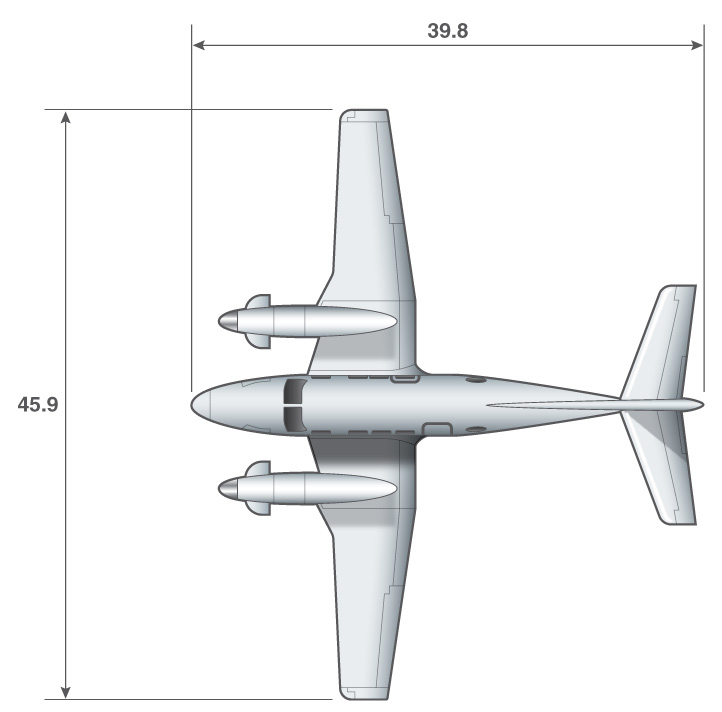
Download the AC90 Rockwell Turbo Commander 690 SVG and reference notes. Prepared on 17 October 2026 from the dimensioned top view on Twin Commander Aircraft's model 690 specification page. Uniformly scaled native vector curves preserve the original wing planform, long nacelles and characteristic horizontal tail. Checked by overlay against the manufacturer drawing.
Download the BE30 Beechcraft King Air 300 SVG and reference notes. Prepared on 17 October 2026 from the original 300/300LW three-view in the Pilot Training Services King Air 300 handbook. Smooth native vector curves follow the compact fuselage, conventional wingtips, paired turboprop nacelles and swept T-tail. Checked by reference overlay.
Download the LJ40 Bombardier Learjet 40 SVG and reference notes. Prepared on 17 October 2026 from Figure 2, printed page 1-4 of Bombardier's Learjet pilot training guide. Type-specific native vector curves preserve the shorter fuselage, aft-swept winglets, rear nacelles, pylons, aft strakes and T-tail. Checked by overlay against the drawing.
Download the C441 Cessna Conquest II SVG and reference notes. Prepared on 17 October 2026 from Figure 1-1, page 1-2 of the Cessna Model 441 Pilot Operating Handbook. Native vector curves preserve the long tapered wings, compact fuselage, twin turboprop nacelles and conventional horizontal tail. Checked by overlay against the manufacturer drawing.
Download the M600 Piper M600 SVG and reference notes. Prepared on 17 October 2026 from Figure 1-1, page 1-2 of the Piper PA-46-600TP information manual. Native vector curves retain the M600 wing, compact fuselage, single nose propeller, conventional tail and right-wing radar pod. Checked by reference overlay.
Download the MU2 short-body Mitsubishi MU-2B SVG and reference notes. Prepared on 17 October 2026 from the short-body MU-2B-20 top view in the Platz painting and marking sheet, with the short-body dimensions cross-checked against FAA AC 150/5300-13, Figure A12-77. Native curves retain the compact fuselage, high wing, twin turboprops and wingtip tanks. Checked by reference overlay; represents the short MU-2B family.
Download the FA20 Dassault Falcon 20 SVG and reference notes. Prepared on 18 October 2026 from Figure 2.2, printed page 8 of Transport Canada report TP 14716E. Native vector curves retain the swept wings and wing fences, rear nacelles and pylons, tapered fuselage and swept tail. Proportions are normalised to the published dimensions; outline checked by reference overlay.
Download the TBM8 SOCATA TBM 850 SVG and reference notes. Prepared on 18 October 2026 from Figure 1.2.1 (2/2), printed page 1.2.2 of the TBM 850 information manual. Native vector curves retain the conventional rounded wingtips, single nose propeller, paired exhausts and conventional tail. Outline checked by reference overlay, with proportions checked against the handbook dimensions.
Download the K900 Daher Kodiak 200 / 900 SVG and reference notes. Prepared on 18 October 2026 from the dimensioned top view on page 2 of Daher's 2026 Kodiak 900 specification poster. Native vector curves retain the stretched fuselage, discontinuous wing leading edge, nose turboprop and conventional tail. Outline checked by reference overlay, with proportions normalised to the published dimensions. Kodiak 200 is the certificated model designation of the Kodiak 900.
Download the G150 Gulfstream G150 SVG and reference notes. Prepared on 19 October 2026 from the dimensioned G150 three-view reproduced in Business & Commercial Aviation, November 2005, page 41. Native vector curves retain the double-swept wings, aft-pointing winglets, paired rear nacelles and pylons, compact fuselage and swept horizontal tail. Checked by source overlay, with proportions normalised to the dimensions in the Gulfstream G150 brochure.
Download the M700 Piper M700 Fury SVG and reference notes. Prepared on 19 October 2026 from the M700 top-view paint-layout sheet, form 250-015, reproduced in a 2025 M700 listing. Native vector curves retain the tapered wing, compact fuselage, paired nose exhausts, right-wing radar pod and conventional tail. Checked by source overlay with proportions normalised to the dimensions in the Piper M700 brochure. The paint sheet is a visual reference rather than a scale engineering drawing.
These are decorative illustrations, not engineering drawings.
Download the C425 Cessna 425 Corsair / Conquest I SVG, transparent PNG and reference notes. Prepared on 23 October 2026 from Airplane Dimensions Figure 1 (Sheet 2), page 3 of the Cessna Model 425 maintenance-manual extract. Native vector curves retain the tapered wings, twin PT6 nacelles, slender propeller bars and conventional horizontal tail. Uniformly scaled, with transparent cockpit and restrained control-surface detail.
Download the PAY2 Piper PA-31T Cheyenne II SVG, transparent PNG and reference notes. Prepared on 24 October 2026 from Figure 2-1, printed page 1B1 (PDF page 25), in the Piper Cheyenne Service Manual. Native symmetric curves retain the original short fuselage, wingtip tanks, paired PT6 nacelles, slender propeller bars and conventional horizontal tail. This is the PA-31T Cheyenne II, rather than the stretched PA-31T2 Cheyenne II XL. Transparent background and cockpit; restrained control-surface detail.
Download the WW24 IAI 1124 Westwind SVG, transparent PNG and reference notes. Prepared on 25 October 2026 from the top view in Astra Jet Corporation / IAI Service Information Letter 1124-20-104, 20 July 1994, printed page 6 of 7 (PDF page 59). Native symmetric curves retain the wingtip tanks, straight tapered wings, twin rear turbofan nacelles and swept horizontal tail. Represents the civil Westwind I configuration. Uniformly scaled; checked by source overlay. Transparent cockpit and restrained control-surface detail.